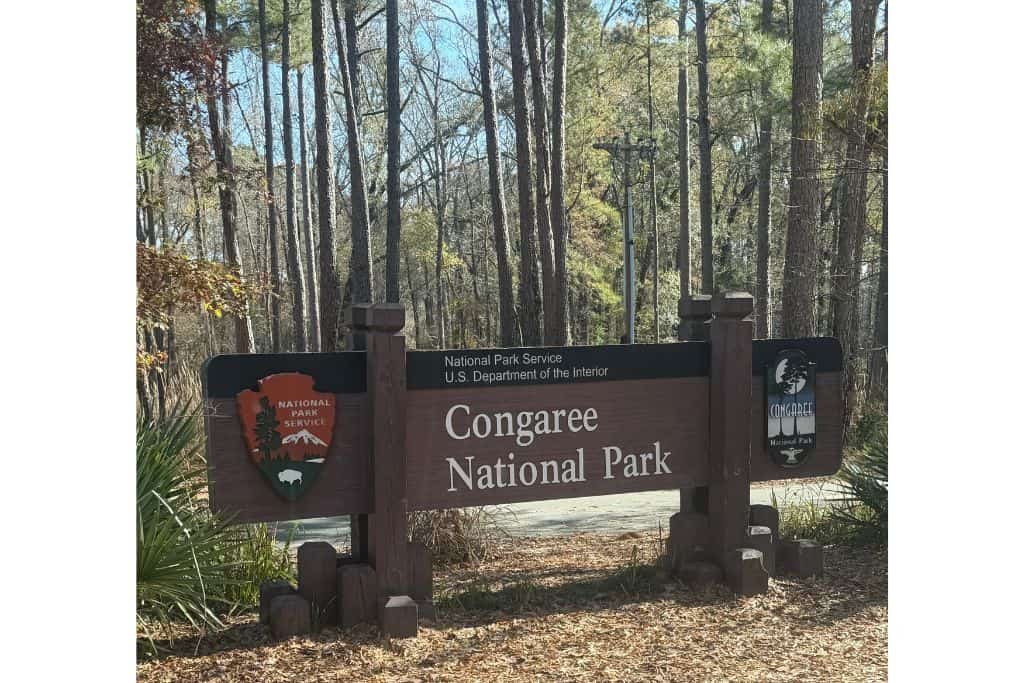
Congaree National Park
Congaree National Park is “the little engine that could” of the parks system. This hidden gem is nestled in the middle of South Carolina and is comprised of about 41 square miles of protected lands that house the largest remaining old-growth floodplain forest in all of North America. The landscape there today would be the closest to what the area looked like 500-1,000 years ago. Huge cypress and swamp tupelo trees jut from various meandering rivers, flood plains and sloughs. This ecosystem is also home to synchronous fireflies that put on an interesting light show every May. There is a lottery you can enter to try to get tickets to view this natural phenomenon. Speaking of tickets, this is a free to enter park, no park pass needed, wow!

There are a couple different options for camping within the park. There are campgrounds in the “front country” section of the park that are walk up tent sites with a fee of $25/night. For our trip to the park we finally had some good weather, (70’s during the day and 50-60 overnight temps) and we were feeling a bit more feral I guess, so we opted for a free backcountry permit and were able to sneak in a two night backpacking trip before another cold snap came.

We quickly changed into shorts and short sleeves after what seemed like freezing for months and trundled on our merry way. Being in possession of a back country permit, we were instructed by the park ranger to leave our van parked in the visitor center parking lot, so that is what we did. This is highly unusual since at most parks there are signs everywhere at the visitor center and even trail heads that there is no overnight parking or at minimum no camping, so that was very convenient to be able to pack up and head right out on the boardwalk and then continue on to the backcountry. The boardwalk is a 2.5 mile loop if you are not into sleeping on the ground or schlepping around all your gear for countless miles and gives a very nice overview of the parks ecosystem.

We walked and adjusted our packs, this was the first overnight for me with my current pack so it took some tweaking to get right. It’s amazing the difference walking with and without a pack. We didn’t have a way to weigh our bags but I would guess that it was around 18-20 pounds. That’s not even half the weight I lost when starting this journey, but it felt like a lot more than that until I acclimated to the heavy pack. There were quite a few downed trees across the paths in the backcountry so everything was just a little bit different with a big pack on as opposed to our small day packs. Balance, where you feel the weight (hello hips and knees), and paying attention to how and where you step are all different. We even had to crawl under a fallen tree on hands and knees to forego taking the whole thing off at one point. Felt good to get a little dirty though!

We saw our last person around 1:30pm on the trail going the other direction and wouldn’t see another for more than 43 hours, perfect. The first day’s hike brought us to a sandbar on the Congaree river, we hiked about 5.6 miles to get there. The trails are marked but due to tree fall and it being back country there was a little bit of stop, look around, see where the last marker was and back track to make sure you continue on in the right direction. We had all sorts of GPS, compass, maps and even a bit of phone signal the entire trip but never had to use anything besides the paper map and paying attention to markers. There were tracks in the sandbar from a multitude of critters and we hoped to see a river otter but, alas, we did not at this location.

After some light morning showers we broke camp and loaded up. Eric normally walks in front of me due to my tendency to stumble, he is there to catch me or throw that patented safety arm bar out that has saved me on a number of occasions and only partially maimed others like on our Grand Canyon hike. For anyone who doesn’t backpack or hike, one little tidbit to think about is that although the early bird gets the worm, the slightly lesser known adage is the early bird also gets a face full of spider webs.

Neither Eric or myself are arachnophobic, but I don’t know that anyone really likes having a face full of spider web and a hat hitchhiker that looks like this. Although these spiders look like pure nightmare fuel (which they are for some I am sure) they are not poisonous and are of the orb weaver variety. Spiders make their webs across the path normally spanning between two branches on either side so they can catch their intended prey (flies, mosquitos, moths) in their web. That means the front hiker gets the web face, womp womp. Eric carried a stick for a while that he waved around like a light saber to catch webs before they made contact with him after the second run in with one of these monsters. It worked pretty well, but that’s a true show of love right there, taking the spiders/webs head on. Keep that in mind for your next romantic holiday such as an anniversary or Valentine’s day, maybe just write a card that says “I’ll hike in front”.

The night before while we were camped by the river, what we could only determine to be a rescue helicopter kept doing fly overs very low to the river. I looked it up in the morning to see if perhaps someone was lost and couldn’t find anything in the news, but I did see that there had been some wildlife management efforts in the past in controlling the wild hog population. We had seen areas where the ground was quite rooted up and wondered what could have done it and therein found the answer. We even got to see the little porkers in action when we heard movement that sounded larger than a squirrel and was followed by a grunt. We were unable to get a photo but saw at least 4 adult hogs and wait for it….about 8 piglets! They were at a distance and in the underbrush but we caught a glimpse as they snorted and lumbered away.

We are always on the lookout for wildlife, especially species we have not seen before in real life, so catching a glimpse of those wild piggy’s was a treat. Important reminder though, all wildlife should be viewed from a distance. Wild boars can be especially dangerous as can many other animals. It is always important to remember you are in their space and if it isn’t safe to take a photo, don’t. We were listening and locating them and making sure we weren’t in between a big angry male and its mate or something like that. Our second day of hiking took us 7.34 miles across the park to another river, this one smaller and filled with those iconic cypress.

Now you might have noticed we camped by water sources both nights. This was absolutely intentional, not only were we hoping to see some wildlife we were also trying to work smarter not harder. A gallon of water weighs 8.34 pounds (that’s almost half the weight of our whole pack!) and we were carrying everything we needed on our backs. Our water bladders in our packs are 2 liters but that isn’t enough for hiking all day and cooking our dehydrated backpacking dinners so to avoid having to carry lots of heavy water all day, we carry a water filter and strategically plan where to filter water so as to carry the least amount of weight while still having enough to drink and make dinner. Some places there are no water sources like in Big Bend where we had to haul a lot more water weight with us.
On this trip, camping by the river in November was alright because it was cool enough that the mosquitos were not insufferable. I can only imagine in the warmer months camping this close to a water source/swampy wetland would not be reasonable. Another bonus to hiking this late in the season is that the snakes are more dormant. There are several venomous danger noodles that live in the park and we were happy to avoid them. Wonder of all wonders, the stars aligned and we saw a river otter in the evening before turning in and then again in the morning three more as shown in the video above. The night sounds at this site were numerous and varied. There were loud water smacks that I can only imagine were otter cannonballs, a pack of coyotes yipping and howling like they had lost their dang minds, and barred owls hooting soft and low night songs.

Waking up next to a river in the middle of a national park with your favorite person to drink coffee while watching river otters play on Thanksgiving morning sure is a lot to be thankful for. We were so grateful to be able to appreciate this land in its natural state and remember the true origins of Thanksgiving as a holiday that stemmed from the Native American philosophy of giving without expecting anything in return and being grateful for the harvest and bounty that the earth provides. The Congaree were a Native American people who originally inhabited this land who are now extinct due to disease introduced by Spanish settlers. Any remaining Congaree would have been absorbed into other tribes such as the Catawba which is the only federally recognized tribe in South Carolina today. Archaeological evidence indicates humans had been inhabiting this area of South Carolina for over 10,000 years, how incredible is that?

We hiked back to the van, only about 3.16 miles, appreciating the cypress giants along the way. I still can’t believe we saw otters and wild hogs (yes these are leftover from Spanish settlers bringing them in). We unpacked our bags into the van and drove over to the coast to watch the sunset. We glimpsed dolphins playing in the water and had a simple Thanksgiving dinner of mac and cheese and a bagged salad. We did however add venison that we harvested ourselves before hitting the road (nod to the Native American offerings at the first Thanksgiving).

Although we of course missed family and friends on this holiday, we are continually grateful to be able to become closer with nature, learn about other states, cultures, cuisines, and to immerse ourselves fully in the world around us. If I can suggest anything it would be to take the trip, go see that “thing” you have always wanted to but maybe are worried would cost too much or its too hard, it doesn’t matter. Just go and do and see, and do it graciously, you won’t regret it. One of our Boondockers Welcome hosts we met along the way said the common saying “you only live once” is all wrong, you actually are fortunate enough to live every single day and you only die once. I really think the most important lesson we are learning in this chapter is to truly LIVE every day without taking it for granted. So here is your sign, if you are reading this it’s time to live every single day you’ve got with intention and gratitude for whatever that day brings.